You can share a home, a bed, a family, and a whole life with someone. You can still feel terribly alone.
Feeling lonely in a relationship usually means there is a gap between the connection you long for and the connection you are actually experiencing. You may still love each other. You may function well as a team. But somewhere along the way, the warmth, curiosity, touch, or heart-to-heart connection between you has gone quiet.
That quiet matters. It does not automatically mean your relationship is over. It is information: something in the way you share, listen, respond, or make room for intimacy needs attention.
Is it normal to feel lonely in a relationship?
Yes. You can feel lonely in a loving relationship, a long-term partnership, or a marriage that looks perfectly stable from the outside.
Being alone is a physical condition. Loneliness is an emotional experience. Researchers often describe it as a discrepancy between the connection a person wants and the connection they experience. That is why you can feel peaceful by yourself and profoundly lonely sitting beside your partner.
People describe this experience in different ways: feeling alone in a relationship, feeling lonely even when in a relationship, being married but lonely, or drifting into what couples often call the roommate phase. This is emotional loneliness. You have company, but not the kind of contact that helps you feel known. Feeling lonely in marriage is not proof that love has disappeared. It is a reason to look more closely at whether connection is moving between you.
A 2024 study of romantic partners in Behavioral Sciences (Sease et al., 14(6):439) found that higher loneliness was associated with lower trust and commitment and greater relationship conflict. Because the study was cross-sectional, it cannot show that loneliness caused those outcomes. It does show how closely relationship well-being and loneliness can travel together.
If you are wondering whether something is wrong with you for feeling this way, look at how common it is. Loneliness inside a relationship is not a rare failure of love. It is one of the most frequent experiences people bring into my office.
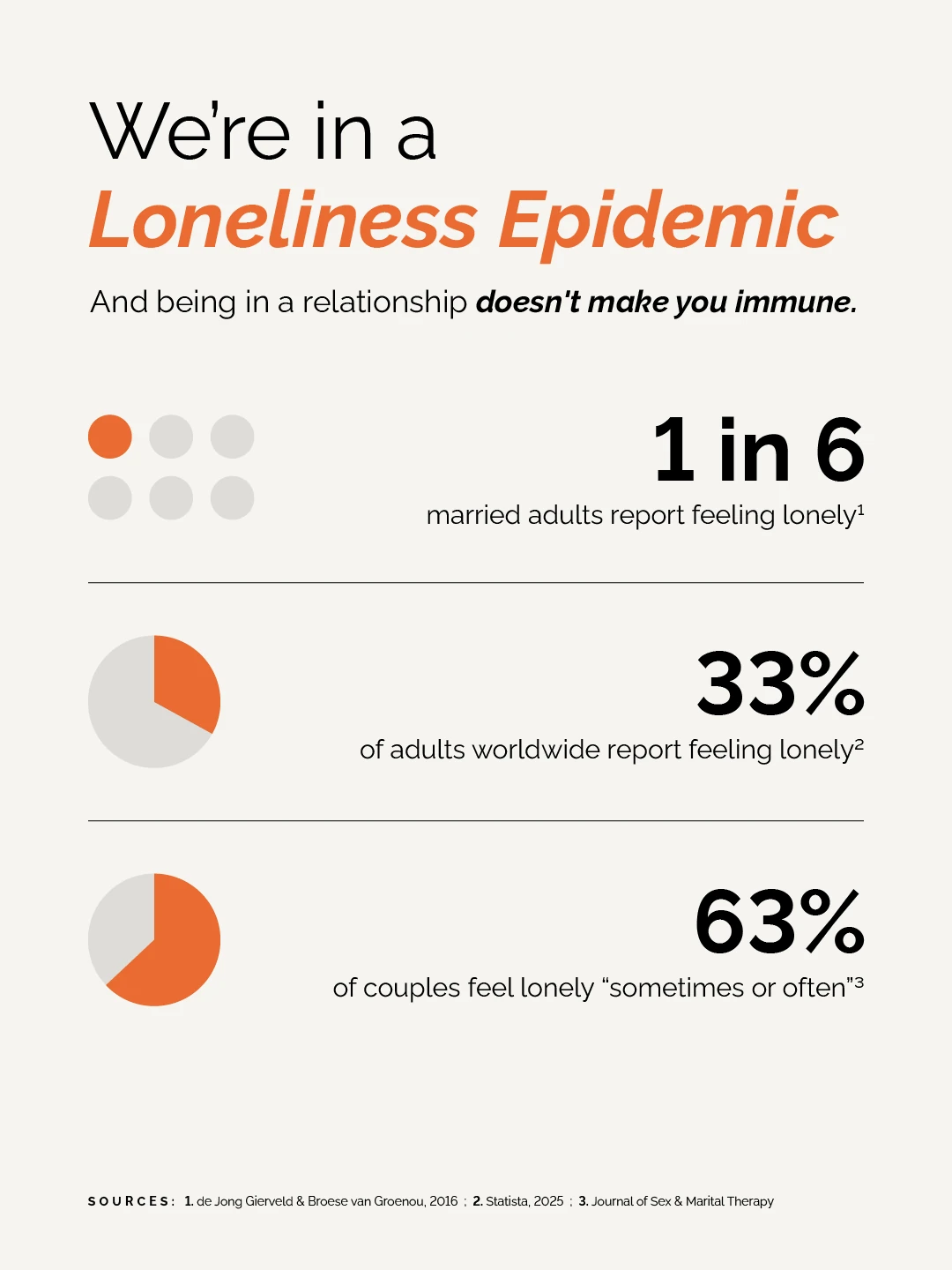
Sixty-three percent is not a fringe experience. It is most couples, at least some of the time. That does not make it acceptable and it is no reason to settle. But it does mean your loneliness is not proof that you chose the wrong person, or that you want too much.
The real question is not only, “How much time do we spend together?” It is, “When we are together, do I feel known, heard, and emotionally met?”
The evidence points at the feeling, not the circumstance. A 2024 meta-analysis in Nature Mental Health following more than 600,000 people found loneliness associated with a higher risk of dementia even after accounting for social contact and depression.
What are the signs of loneliness in a relationship?
Relationship loneliness is often quiet. Feeling alone in a relationship can be especially confusing because there may be no affair, explosive conflict, or obvious crisis. From the outside, everything may look fine.
Inside the relationship, you may notice that:
- Talk is all logistics. Children, work, schedules, the household — and the small details have stopped being shared.
- You are together but separate. Side by side on different screens, more like efficient roommates than lovers.
- You do the reaching. You miss your partner in the same room, and you are always the one to initiate.
- The truth does not feel safe. You expect defensiveness or withdrawal, and when either of you does open up, it does not land.
- Affection has gone quiet. Sex is infrequent or mechanical — and you have begun telling yourself that wanting more makes you needy.
There is a particular kind of pain in being lonely next to the person you most want to reach. Wanting closeness is not a character flaw. It is a deeply human longing.
Feeling alone in family relationships can deepen the experience. You may be surrounded by a partner, children, or relatives while carrying the emotional life of the household by yourself. The number of people around you does not tell whether you feel connected to them.
Why do I feel lonely in my relationship?
In more than four decades of working with couples, I have learned that relationship and marriage loneliness rarely has one cause. It usually develops through a pattern of missed connection, self-protection, and failed repair.
If your first thought is, “Why do I feel lonely when I have someone?” start by resisting the urge to turn the feeling into a verdict. Loneliness is a signal. The work is to discover what kind of connection is missing, how the pattern developed, and whether both partners are willing to address it.
Loneliness inside a relationship almost never has a single cause. In Relational Life Therapy we see eight patterns that account for most of it:
- Side by side, never nose to nose. The relationship has become logistics, with no time turned toward each other.
- Transmission or reception has stopped. One partner stopped sharing, or the other stopped taking it in.
- Truth-telling went badly, so it stopped. Past attempts became arguments, and silence started to feel safer.
- Self-protection is blocking contact. Criticism, withdrawal and numbing shield you from disappointment and from closeness at once.
- A pursue-withdraw cycle has taken hold. The harder one reaches, the further the other pulls back.
- Overthinking is amplifying uncertainty. Anxiety fills in answers instead of asking questions.
- One person is expected to meet every need.
- Life circumstances or clinical concerns — a new baby, grief, illness, menopause, depression, trauma, substance use — are limiting the capacity to connect.
Your relationship has become all side by side and no nose to nose
Every long-term relationship needs both kinds of energy.
Side-by-side connection is the partnership of daily life: raising children, paying bills, planning meals, caring for family, and getting everyone where they need to go.
Nose-to-nose connection is when the relationship itself becomes the focus. You turn toward each other, open your hearts, share what is happening inside, enjoy each other, and remember that you are lovers, not only coworkers running a small organization.
Daily life naturally pulls couples toward side-by-side living. Work, parenting, caregiving, illness, and plain exhaustion can push the relationship to the bottom of the list. The relationship may not collapse. It simply becomes underfed.
One of you stopped sharing, or the other stopped receiving
It isn’t that the silent couple has nothing to say to each other. It’s more often that they have too much to say to each other and no way of saying it.
Intimacy moves in two directions. I share something of myself; you take it in and let me know it matters. Then you share, and I receive you.
I call those movements transmission and reception. Loneliness grows when one person stops transmitting, when the other person stops receiving, or when both happen at once.
Feeling unheard in a relationship usually starts here. You may be able to describe your feelings but meet a wall, a solution, a rebuttal, or a volley of criticism. Your partner may have a rich inner life but struggle to put it into words. Both people can leave the same room convinced that the other one does not care.
You have stopped telling the truth because telling it went badly
Perhaps you tried to say you felt neglected and the conversation became an argument. Perhaps your partner heard criticism where you meant longing. Perhaps you were dismissed, mocked, corrected, or told that your feelings were the problem.
After enough disappointing attempts, silence can feel safer. But unspoken hurt does not disappear. It hardens into resentment, and resentment dries up generosity. What looks like acceptance may actually be resignation.
This is the bind: taking on the problem can feel risky, but not taking it on is risky too. It is simply quieter.
You are protecting yourself from the vulnerability intimacy requires
A complaint can feel powerful: “You never listen.” A request is more vulnerable: “Would you put your phone away and listen to me for ten minutes?” The other person could say no. That possibility can hurt.
So we criticize, withdraw, numb out, or pretend not to need anything. These protections make sense, especially if you have reached before and been disappointed. But the shield that protects you from disappointment also blocks contact.
You can protect yourself or you can work on being intimate, but you can’t do both at the same time.
You are caught in a pursue-withdraw cycle
One partner reaches harder, complains louder, or asks the same question repeatedly. The other feels criticized, flooded, or ashamed and pulls away. The more one pursues, the more the other withdraws; the more one withdraws, the more urgently the other pursues.
Both people may be protecting themselves. Both may also be intensifying the loneliness they are trying to escape.
She says, “We never talk anymore.” He hears an accusation, goes quiet, and waits for it to pass. She reads the silence as proof that he does not care, so she says it again, louder. He retreats further. Neither of them is trying to create distance. The pattern is doing it for them.
Researchers call this demand-withdraw, and they have followed couples over time to see how it unfolds. The important thing to know is that the cycle is self-feeding: it does not need anyone to be at fault to keep going.
Overthinking can amplify uncertainty, but it is not the whole story
Overthinking in a relationship can keep you scanning every delayed reply, flat tone, or quiet evening for proof that love has disappeared. Anxiety can intensify loneliness, especially when you are trying to read your partner’s mind instead of asking what is happening.
But do not use “I am overthinking” to dismiss a real pattern. Slow yourself down, separate what you know from the story you are telling yourself, and then bring the concern into the relationship as a clear question or request.
You expect one person to meet every need
Your partner matters enormously. They still cannot be your lover, best friend, intellectual companion, emotional confidant, creative community, spiritual home, and enthusiastic audience for every interest at every moment.
We long for perfect attunement, but we marry real human beings. There is a difference between accepting normal human limitation and settling for chronic neglect. Part of mature love is learning which needs belong inside the couple, which can also be met through friendship and community, and which absences are too important to ignore.
Life circumstances or clinical concerns are affecting connection
Having a baby, raising children, grief, menopause, illness, retirement, relocation, neurodivergence, sustained work stress, depression, anxiety, trauma, chronic pain, substance use, and other concerns can all shape a couple’s capacity for connection.
These factors deserve care in their own right. Not every form of loneliness can be resolved through communication skills alone.
Five types of intimacy that shape connection
When people say, “We are not close anymore,” they often mean emotional closeness. But intimacy has more than one dimension.
In Relational Life Therapy, the approach I developed to help couples move out of painful patterns and back into connection, we look at five domains:
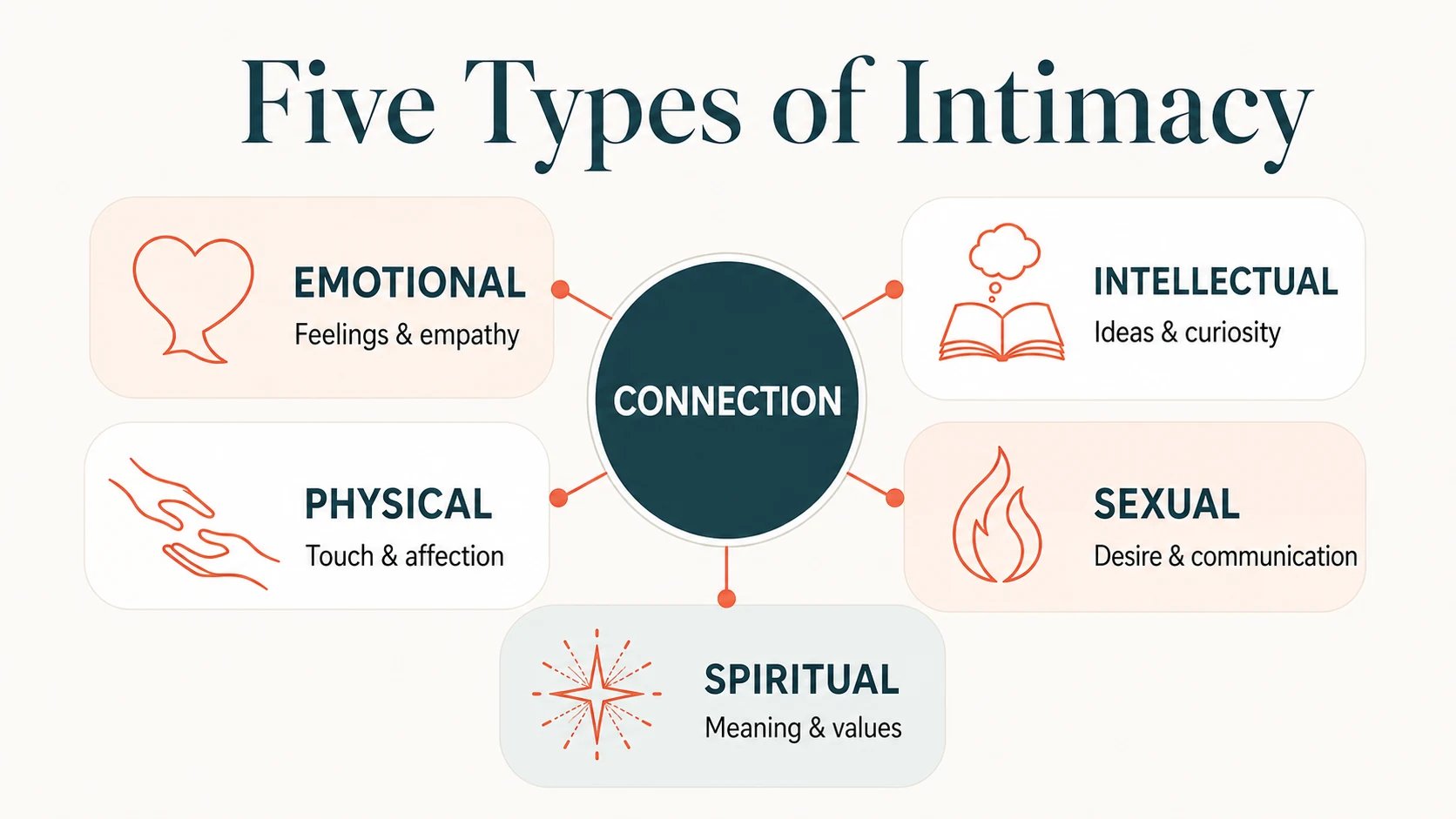
- Intellectual intimacy: sharing ideas, interests, books, opinions, and curiosity.
- Physical intimacy: affectionate touch, comfort, warmth, and physical presence that is not automatically a demand for sex.
- Sexual intimacy: sharing desire, pleasure, boundaries, and honest conversation about your erotic life.
- Spiritual intimacy: sharing or respecting what gives life meaning, whether that is faith, creativity, nature, service, or purpose.
- Emotional intimacy: sharing feelings and vulnerability and having your inner experience met with curiosity and compassion.
What most couples name as a lack of emotional intimacy is often a shortage in one specific domain rather than all five. You do not need identical scores in every domain. One partner may crave intellectual exchange while the other feels closest through physical affection. The difference is not automatically the problem. The problem is often that the difference has never been named, understood, or negotiated.
Try the intimacy inventory
For each of the five domains, rate these four pathways from 1, “rarely there,” to 5, “flows easily”:
- How well do I share or transmit?
- How well do I take in or receive my partner?
- How well does my partner share or transmit?
- How well does my partner take me in?
This is more useful than deciding who is “the bad communicator.” It shows you where the channel between you has gone quiet and where it is still alive.
Working through the inventory alone can be revealing. Working through it with guidance is usually where it gets interesting, because the domain you score lowest is rarely the one you expected. I take couples through this exercise in my workshop on loneliness in relationships, along with what to do once you see the pattern.
How to stop feeling lonely in a relationship
You cannot order closeness on demand. You can create better conditions for it. Begin by identifying the connection you miss and making one clear request. Start with the steps you can take, then pay close attention to whether your partner is willing and able to meet you.
What helps depends on the source of the distance. If the relationship is starved for attention, protected time may help. If important truths remain unsaid, honest communication may help. If your partner is unwilling or unable to engage, support, boundaries, and professional guidance may matter more.
Do not try to repair everything at once. Choose the smallest honest conversation that could show you whether there is still movement between you.
Ten steps make up the way back, roughly in order:
- Put the relationship back on the list
- Get specific about the connection you miss
- Dare to rock the boat with loving power
- Move from complaint to request
- Teach your partner how to succeed with you
- Learn acknowledged receptivity
- Repair one hurt at a time
- Take space responsibly
- Build a wider circle of connection
- Know when to get help
1. Put the relationship back on the list
Do not wait for intimacy to happen spontaneously after every other demand has been met. By then, both of you may be exhausted.
Protect a small, repeatable pocket of nose-to-nose time. It need not be an elaborate date. Take a walk, share pizza, sit together without phones, or have coffee before the house wakes up. For that time, do not discuss only logistics. Ask about each other’s hearts.
More time alone will not repair contempt, fear, addiction, or entrenched withdrawal. But when the connection is simply starved, regular attention gives it somewhere to live.
2. Get specific about the connection you miss
“I feel lonely” is honest, but broad. Before you talk, ask yourself:
- Do I want more affection?
- Do I want my partner to ask about my inner life?
- Do I want more play, intellectual exchange, or shared meaning?
- Do I want a richer sexual connection?
- Do I need help carrying the practical load so I have energy left for intimacy?
- Do I want my partner to stay present when I am upset instead of fixing, defending, or leaving?
Specificity gives your partner something they can understand and act on.
3. Dare to rock the boat with loving power
Do not act happy when you are not. Stand up for what you need without turning your partner into the enemy.
Loving power is firm and cherishing at the same time: “I love you. I want us. And this distance is not working for me. I need us to take it seriously.”
That has a different energy from silence, attack, or “I have finally found my voice, and I do not care how I use it.” Relational empowerment is not power over your partner. It is power with them, in service of the relationship you share.
More assertion up front, less resentment on the back end.
4. Move from complaint to request
In the middle of every complaint, there’s a request.
Instead of downloading everything your partner is doing wrong, find the request hidden inside the complaint.
If you are wondering how to communicate feeling lonely in a relationship, do not lead with a verdict about your partner’s character. Describe your experience, say what you miss, and ask for one concrete change that would help you feel closer.
Complaint: “You are always on your phone. You never listen to me.”
Request: “I love you, and I miss you. Would you put your phone away and give me ten minutes of attention after dinner?”
Most people find that distinction easy to understand and hard to deliver. Reading it on the page is one thing; saying it out loud to the person who has disappointed you is another. It is one of the things that need practice, including what to do when the request lands badly anyway.
A useful request is:
- Positive: it says what you want, not only what you want stopped.
- Specific: your partner can picture the behavior.
- Behavioral: it asks for something they can actually do.
- Respectful: it comes from your experience rather than declaring who your partner is.
- Relational: it explains how the request could help the two of you.
For a short companion lesson, I invite you to watch How to Get More of What You Want From Your Relationship.
5. Teach your partner how to succeed with you
Do not expect your partner to read your mind, then punish them for failing the test.
If you need empathy rather than solutions, say so: “I want ten minutes of listening. Please do not fix it yet. Tell me what you hear and help me feel that you understand.”
If you want affection that will not automatically become sexual, ask for that boundary clearly. If you need your partner to return after taking space, agree on when they will come back.
Teaching your partner is not declaring what a good person should do. It is telling them, with humility, what helps you feel loved.
6. Learn acknowledged receptivity
Listening is hardest when your partner is describing pain connected to something you did. Your nervous system may want to explain your intentions, check the facts, solve the problem, or bring up your own complaint.
Slow down. Your first job is not to decide whether your partner’s experience is objectively correct. Your first job is to understand it.
Try:
- “This is what I hear you saying. Did I get it right?”
- “I can understand how you might feel like that.”
- “That sounds painful. Tell me more.”
- “What could I say or do right now that would help you feel better?”
Understanding is not the same as agreeing with every conclusion. It tells your partner that their experience can exist in the room without being erased.
7. Repair one hurt at a time
When you need to clear the air, I use a practice called the feedback wheel. Begin by remembering love: make sure the part of you speaking genuinely wants to make things better, not prove that you are right and your partner is wrong. Ask whether it is a good time. Then keep each step brief:
- What happened: “As I remember it…”
- The story I told myself: “What I made it mean was…”
- What I felt: include both the emotion you know well and the vulnerability or power beneath it.
- What would help now: make one clear request.
The listener reflects what they heard, offers compassion, takes accountability for what they can own, and gives what they reasonably can. Their own issue gets another conversation. Repair is a one-way street while it is happening.
If reading that made you think we would never make it past step two, you are in ordinary company. Knowing the steps and being able to use them when you are hurt are two different skills, and the second one is learned by practice. That is most of what we do in the loneliness workshop: bringing up a hurt without it turning into the same fight.
8. Take space responsibly
Some people need time to identify what they feel and find words. That is legitimate. Disappearing indefinitely is not.
Try: “There is something on my mind, but I am not ready to say it well. Give me an hour. I promise I will come back to you by 7:00.” Then return at the agreed time and initiate the conversation yourself.
This is responsible distance-taking, and I have written a fuller set of rules for it. The more reliably you take care of your partner while asking for space, the less urgently they may need to pursue you.
9. Build a wider circle of connection
Learning how to cope with feeling lonely in a relationship also means building a wider circle of connection. No one person can meet every relational need. Friendships, family, community, creative work, spiritual life, and appropriate professional support all matter.
Going outside the couple for friendship or intellectual companionship is not a failure of intimacy. It can relieve impossible pressure on the relationship. It does not mean avoiding an important problem between you, and it does not override whatever agreements you have made about sexual or romantic exclusivity.
10. Know when to get help
When do you need help? When you can’t do it yourself.
Consider working with a qualified couples therapist when:
- Every conversation becomes the same fight, and neither of you can hear a request without collapsing into shame or counterattacking.
- One or both of you repeatedly shuts down, attacks, or leaves.
- Resentment has replaced warmth, and affection or sex has disappeared without either of you able to discuss it.
- Alcohol, substance use, trauma, neurodivergence, or mental health concerns need more tailored support than couples work alone.
- You have tried to reconnect and remain stuck, or you are unsure whether to repair the relationship or leave it.
Couples work is not only for relationships on the verge of ending. It gives structure to two people who may care deeply but no longer know how to reach each other.
If there is coercion, intimidation, or physical, sexual, or emotional abuse, ordinary communication advice may be inappropriate or unsafe. Seek individualized professional support and prioritize safety. If you are in immediate danger, contact local emergency services. In the United States, you can also contact the National Domestic Violence Hotline for guidance.
What if my partner will not work on the relationship?
Start by separating three very different situations.
- Your approach may need more skill. Ask positively, specifically, and with loving power. Choose the moment. Keep the issue bite-sized. Make it easier for your partner to hear what you mean.
- The two of you may need help. If the conversation is not getting through, bring in a qualified RLT therapist. For concerns involving sex, substance use, trauma, or neurodivergence, look for someone with relevant training in addition to general couples experience.
- You may be facing a real limit. If you have asked clearly, tried skillfully, sought appropriate help, and your partner remains unwilling or unable to engage, the task shifts from changing them to deciding what you can live with.
One person can change the dance, sometimes dramatically. One person cannot create mutual intimacy alone.
Does emotional distance mean your relationship is over?
Not necessarily. Loneliness tells you that something important is missing. It does not tell you, by itself, whether the relationship can or should continue.
Pay attention to what happens when the truth is named. Does your partner become curious? Can each of you take responsibility for your part? Do requests lead to real effort, even if imperfect? Can hurt be repaired? Is the relationship safe?
No flesh-and-blood partner will meet you perfectly in every domain. Mature love includes disappointment. The question is whether you are accepting ordinary human limitation or abandoning something essential in yourself.
When I reach this point with someone, I ask what I call a relational reckoning:
Am I getting enough in this relationship to make grieving what I’m not getting worth my while?
If the honest answer is yes, grieve what is missing and turn toward what your partner does give you. Do not spend the rest of your life as a resentful victim of an imperfection you have chosen to accept.
If the answer is no, and you have made the problem clear, used your best skills, and sought meaningful help, take that answer seriously. I have written separately about when to end a relationship. The decision belongs to you. Good support should help you make it soberly, not make it for you.
How to reconnect when you have grown apart
Many couples assume that emotional disconnection in a marriage is simply what happens after years together: passion fades, conversations become practical, and loneliness becomes the price of stability.
That is not the only possible story.
You may not recreate the beginning of your relationship, nor should you have to. You can build a more deliberate intimacy. Two separate people can learn to tell the truth, receive each other, make clear requests, and repair the distance every real relationship sometimes creates.
We want to be lifelong lovers. But as I like to say “We have filet mignon ambition and hamburger skills.” The good news is that relational skills can be learned.
Your loneliness is not something to be ashamed of. Listen to what it is asking for.
Frequently asked questions about loneliness in relationships
Real questions that people who feel lonely in relationships and marriages ask:
Can you love someone and still feel lonely with them?
Yes. Love and connection are related, but they are not identical. You can care deeply about your partner while missing vulnerability, affection, curiosity, sexual intimacy, or the feeling of being received. Love may be present while the pathways that carry intimacy have gone quiet.
Does feeling lonely mean my boyfriend does not love me anymore?
Not necessarily. Slow down before turning loneliness into proof. Emotional distance can reflect stress, avoidance, unresolved hurt, different needs, or simple neglect. Ask what has changed, name what you miss, and watch whether he responds with curiosity and effort. His response over time will tell you more than guesswork can.
What does lonely wife syndrome mean?
People use the phrase in more than one way. It can describe a wife who feels chronically unseen, unheard, or emotionally unsupported. It is also used for the point at which she stops asking for change and begins withdrawing from the marriage. It should not reduce a complex relationship to a label.
What if my partner hears every request as a complaint?
Make the request positive, specific, and rooted in your experience. Lead with love, name what you want the two of you to build, and ask for one behavior rather than presenting a case against your partner. If even careful requests consistently trigger shame, rage, dismissal, or retaliation, stop repeating the same conversation and seek qualified support.
What if my partner struggles to identify or express feelings?
Do not assume that difficulty naming feelings means an absence of feeling or love. Some people need help slowing down, recognizing sensations, and learning emotional vocabulary. Neurodivergence, family history, trauma, or gender socialization may all play a part. A therapist can turn “I am incapable” into skills that are learned.
What if my partner needs a long time before they can talk?
Allow time, but create a clear agreement. The partner taking space should say what they need and when they will return, then come back without being chased. “Give me an hour and I will come find you by 7:00” protects both the need for regulation and the need for reliable connection.
What if there is no sex in the relationship?
A long sexual dry spell is common, but it should not be dismissed if either partner is hurting. Talk about physical affection and sexual intimacy separately; pressure around sex can make even nonsexual touch feel unsafe. If you have not been able to change the pattern together, consider a couples therapist with specialized training in sexual concerns.
What if alcohol makes real communication impossible?
Do not try to resolve important relationship issues while either person is impaired. A partner may reject a label such as “drinking problem” and still have a relationship problem if alcohol repeatedly makes connection impossible. Seek support from a clinician who understands both couples work and substance use.
Can one person fix a lonely relationship?
One person can speak more clearly, listen better, set healthier boundaries, make requests, and stop feeding an old pattern. Those changes can influence the relationship. Mutual intimacy, however, requires participation from both partners. You are responsible for your side, not for doing both sides alone.
Why have I felt lonely in many different relationships?
Look at both the relationships you have chosen and the patterns you bring into them. Repeated loneliness may reflect partners who were unavailable, difficulty trusting or receiving connection, old betrayals, neurodivergence, or depression. This is not a reason to blame yourself. It is a reason to explore the pattern with skilled support.
Does feeling lonely mean I should leave my marriage?
Loneliness alone cannot answer that question. Consider whether the relationship is safe, whether your partner can hear and respond, whether meaningful repair is possible, and what happens over time after you clearly ask for what you need. If you are still uncertain, a qualified therapist can help you conduct a relational reckoning without dictating the decision.
When should we consider couples therapy?
Consider it when loneliness is persistent, your conversations repeat the same cycle, resentment is growing, physical or emotional intimacy cannot be discussed constructively, or one partner’s efforts are not reaching the other. You do not need to wait for a crisis.
If you are ready, or if you have already decided to try couples therapy, it matters a great deal who you do that work with. Our directory lists certified Relational Life therapists around the world, many of whom see couples in person as well as online. You can find one near you in the RLT therapist directory.